7 Tips to Choose the Right Container Size for Sea Freight

Time:2026-10-16 Author:Mason
0%

Choosing a container is more than picking the largest available steel box. It affects freight cost, cargo protection, loading time, and even emissions. For shippers, the real question is how to choose the right shipping container size for sea freight without paying for unused space.

Lars Jensen, founder of Vespucci Maritime and a respected container-shipping analyst, says, “A container is not just a box; it is part of the transport system.” This simple observation deserves attention. A 20-foot container may suit dense machinery, boxed tools, or palletized goods with limited volume. A 40-foot container offers more floor space for lighter, bulky cargo. A 40-foot high-cube container adds vertical capacity, but only when the cargo dimensions and handling equipment allow it.

Measure everything carefully. Record each carton’s length, width, height, weight, and stacking limits. Then compare the total cubic volume with the container’s usable capacity. Leave room for securing materials, doors, and uneven shapes. A perfect calculation on paper may fail beside a real loading bay.

The following seven tips examine container dimensions, cargo weight, packing methods, accessibility, equipment needs, cost, and future shipment patterns. They also consider a common mistake: choosing based on volume alone. That approach sometimes looks efficient. It may not be. Heavy cargo can reach the weight limit before the container appears full, while fragile products may need space between packages. Careful planning remains the safer, more reliable choice.
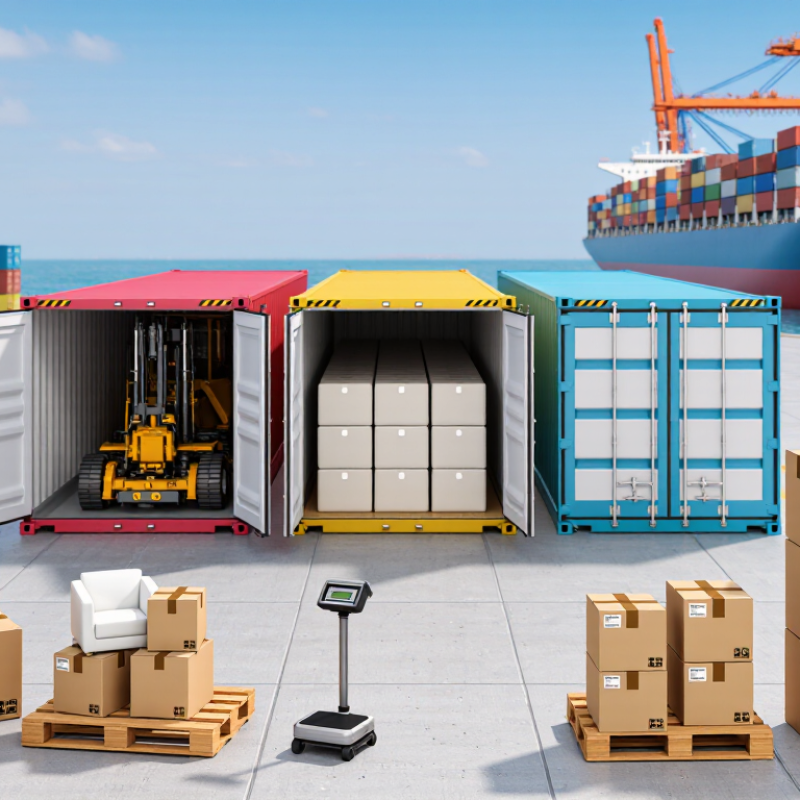
7 Tips to Choose the Right Container Size for Sea Freight

Understanding Standard Sea Freight Container Types and Dimensions

Choosing a sea freight container starts with its internal dimensions, not its advertised size. A standard 20-foot container usually offers about 5.9 meters of length, 2.35 meters of width, and 2.39 meters of internal height. A 40-foot container keeps a similar width and height but provides nearly double the floor length. Dimensions can vary slightly between units.

Container Types
A high-cube container adds roughly 30 centimeters of height, making it useful for tall cartons or stacked pallets. Check the door opening, not only the interior space. A tall package may fit inside but fail at the entrance. Refrigerated containers have thicker walls and less usable volume. Open-top containers suit over-height cargo, while flat racks handle unusually wide or heavy loads. These types often involve different loading limits and handling requirements.

Measure every carton, pallet, and machine, including corners and protective materials. Leave room for doors, bracing, ventilation, and safe weight distribution. Compare the cargo’s total volume with the container’s payload limit. Volume alone can mislead. A dense load may reach the weight limit long before the container looks full. I would recheck measurements after packing, because packaging often changes the final footprint. A simple sketch can expose wasted space. My rough estimate has sometimes looked convincing and still been wrong. Confirm the container’s tare weight, maximum gross weight, and available payload with reliable shipping documents before booking.

Calculating Cargo Volume, Weight, and Space Requirements

Choosing the right sea container starts with accurate measurements, not guesswork. Measure each carton, pallet, or crate in centimeters. Multiply length, width, and height, then divide by 1,000,000 for cubic meters. Measure irregular cargo by its largest rectangular envelope. Empty corners still require space. Measure twice.

Calculate gross weight, including packaging, pallets, straps, and moisture protection. Compare the total with the container’s verified payload limit, not its advertised volume alone. A container may have enough cubic capacity but exceed its safe weight. Distribute heavy cargo across the floor, keeping the center of gravity low. Avoid placing dense items against one door.

Allow space for loading tools, bracing, ventilation, and uneven packaging. Ten to fifteen percent extra volume can be sensible for mixed cargo, although tightly packed uniform cartons may need less. Check internal length, width, height, and door opening dimensions against the largest package. These measurements often differ. My early estimates were too optimistic because I ignored pallet overhang and corner protection.

Create a loading plan before booking. Mark each package’s dimensions and weight on a simple worksheet. Test whether the arrangement leaves usable aisles and balanced floor pressure. Recheck the figures after final packing. Small changes in packaging can alter both volume and payload. When the calculation remains uncertain, use a qualified freight professional to review the measurements and loading method.

7 Tips to Choose the Right Container Size for Sea Freight - Calculating Cargo Volume, Weight, and Space Requirements

Tip What to Calculate or Check Practical Formula or Reference Illustrative Example Recommended Action
1. Measure the total cargo volume Measure the packed length, width, and height of every carton, pallet, crate, or machine. Cubic meters (m³) = length (m) × width (m) × height (m) × quantity 40 cartons measuring 0.60 × 0.40 × 0.35 m:
40 × 0.084 = 3.36 m³
Use the outside packed dimensions, including pallets, skids, protective materials, and crates.
2. Compare the shipment with standard container capacity Compare the measured volume with typical internal dimensions and nominal capacity. 20-foot dry: approximately 33.0 m³
40-foot dry: approximately 67.5 m³
40-foot high cube: approximately 76.0 m³
A shipment measuring 28 m³ may fit a 20-foot container by volume, but the final decision also depends on weight, shape, and loading access. Treat published capacity as a maximum. Reserve space for load securing and irregular shapes.
3. Check cargo weight and payload Add the net weight of all cargo and the weight of pallets, packaging, blocking, and securing materials. Payload = maximum gross weight − container tare weight If a container has a 30,480 kg maximum gross weight and a 3,800 kg tare weight, the nominal payload is about 26,680 kg. Verify the container's door plate and the carrier's permitted payload. Road and rail limits may be lower than the container rating.
4. Allow usable-space clearance Account for aisles, voids, corner posts, uneven cargo, door clearance, and lashing points. Planning volume = nominal container volume × 85% to 90% A 40-foot dry container with about 67.5 m³ nominal capacity provides a practical planning range of approximately 57.4–60.8 m³. Use the lower end of the range for mixed-size cargo or difficult-to-stack packages.
5. Select the height that matches the cargo Check both the cargo height and the available internal door height. Typical internal height:
Standard dry: about 2.39 m
High cube: about 2.69 m
A high cube provides roughly 30 cm of additional internal height compared with a standard dry container. Choose a high cube for tall, lightweight cargo only after confirming door height and route availability.
6. Test the loading pattern and weight distribution Confirm that packages can pass through the doors and that the load can be distributed safely across the floor. Floor loading check: total weight ÷ cargo floor area; also review concentrated-load limits. A typical 40-foot container has an internal floor area of roughly 28.3 m² based on 12.03 × 2.35 m. Keep the center of gravity low, avoid excessive weight at one end, and use dunnage when cargo has small contact areas.
7. Add a realistic buffer before booking Allow for final packing changes, dimensional variation, securing materials, and operational tolerances. Buffered volume = calculated cargo volume × 1.05 to 1.10 For 30 m³ of measured cargo, a 10% buffer gives:
30 × 1.10 = 33 m³
Recalculate after palletizing and obtain final approval using the carrier's equipment specifications and route restrictions.

Reference note: Container dimensions, tare weights, maximum gross weights, and permitted payloads vary by equipment specification, operating route, and local regulations. Confirm the exact values from the container data plate and the shipping provider before booking.

Matching Cargo Characteristics to the Appropriate Container Size

7 Tips to Choose the Right Container Size for Sea Freight

Container choice begins with cargo, not habit. Measure length, width, height, and gross weight for every packing unit. A 20-foot dry container offers roughly 33 cubic meters, while a 40-foot unit provides about 67. Actual usable space is lower. Door openings, corner posts, lashing points, and pallet overhang consume practical capacity. UNCTAD’s Review of Maritime Transport 2024 confirms that over 80% of world merchandise trade by volume moves by sea. That scale makes small planning errors expensive.

Match density to equipment. Heavy machinery may reach the weight limit before filling the floor. Light, bulky cartons may need a 40-foot high-cube container instead. Check the container’s CSC safety plate and the carrier’s declared payload. Never rely on nominal capacity alone. Temperature-sensitive goods require controlled equipment, while moisture-sensitive cargo needs suitable packaging and desiccants. Fragile pieces need void control, edge protection, and a loading plan that prevents shifting. The IMO Code of Safe Practice for Cargo Stowage and Securing stresses securing cargo against movement during transport.

Seven practical checks help: volume, weight, dimensions, center of gravity, loading sequence, protection, and route availability. Confirm whether doors can accept the tallest pallet. Leave no hidden gaps around irregular items. Photograph the loaded condition. That record supports claims and later training. One imperfect estimate can force a costly split shipment. Recalculate when packaging changes; cartons often grow after protective materials are added. Container selection is technical, but it is not perfectly predictable.

7 Tips to Choose the Right Container Size for Sea Freight

Match cargo characteristics to the appropriate container size by comparing internal volume with approximate payload capacity. Use a 20-foot container for dense, heavy cargo; choose a 40-foot or 40-foot high-cube container for bulky, lower-density cargo.

Approximate ISO container specifications: actual dimensions, tare weight, and payload limits vary by equipment type, carrier, route, and local regulations.

Evaluating Loading Methods, Packaging, and Space Efficiency

7 Tips to Choose the Right Container Size for Sea Freight

Container choice should begin with the cargo, not the available equipment. A standard 20-foot container offers about 33 cubic meters, while a 40-foot high-cube provides roughly 76 cubic meters. These figures are approximate. Door openings, corner posts, and uneven cargo reduce usable space. UNCTAD’s Review of Maritime Transport 2024 recorded global seaborne trade at about 12.3 billion tons in 2023. That scale makes small loading errors expensive. Measure every carton, pallet, and handling gap before booking. Then compare volume with gross weight, because a full-looking container may still be weight-limited.

Packaging determines real efficiency. Use compatible pallet footprints, stable cartons, and limited overhang. Vertical stacking can improve utilization, but only when box compression strength supports it. Heavy goods belong low and near the centerline. Lighter packages can fill upper voids. Dunnage, blocking, and lashing should prevent movement without crushing packages. The World Shipping Council reported 221 containers lost at sea in 2023, compared with 661 in 2022. Secure loading remains essential. A loading plan is useful, but not perfect. Carton deformation, moisture protection, and forklift access can change the result on-site. Recheck the plan after a physical trial, especially when irregular machinery or mixed pallet sizes are involved.

Checking Shipping Rules, Costs, and Final Container Selection

Choosing the right sea-freight container begins with the cargo, not the quoted price. Measure length, width, height, and weight after packing. Leave space for doors, corner posts, and safe handling. A 20-foot container may suit dense machinery, while a 40-foot unit often fits lighter, bulky cartons. Do not assume more volume means lower cost.

Check shipping rules carefully. The International Maritime Organization’s SOLAS regulation requires a verified gross mass before loading. Your packing list, commercial invoice, and weight records should agree. Confirm restrictions on wood packaging, batteries, liquids, temperature-sensitive goods, and oversized cargo. UNCTAD reports that ships carry over 80% of global merchandise trade by volume, so small documentation errors can create serious delays across busy networks.

Compare the full cost, not freight alone. Request separate figures for ocean freight, terminal handling, documentation, customs clearance, storage, and trucking. Ask how long the rate remains valid. Fuel adjustments and congestion surcharges can change the final amount. Industry planning reports consistently show that schedule reliability remains a major supply-chain concern, even when capacity is available. Select the container only after checking route limits, cut-off times, payload, and delivery access. Photograph the cargo before closing the doors. A simple checklist helps. I still review it twice, because “standard” cargo is rarely perfectly standard.

FAQS

What are the internal dimensions of a standard 20-foot container?

It usually measures about 5.9 meters long, 2.35 meters wide, and 2.39 meters high inside. Dimensions vary slightly.

How does a 40-foot container differ from a 20-foot container?

It keeps a similar width and height but offers nearly twice the floor length. Check the actual unit before booking.

When should I choose a high-cube container?

Choose it for tall cartons or stacked pallets. It adds roughly 30 centimeters of height. Measure the door opening too.

Can cargo fit inside but fail during loading?

Yes. Interior space may look sufficient, but the doorway, corner posts, or forklift path may block entry. Measure the entrance.

How should I compare cargo volume with container capacity?

Compare total volume with payload limits. A dense machine may reach the weight limit before the container looks full.

Are refrigerated containers suitable for all cargo?

No. Their thicker walls reduce usable space. Confirm the internal dimensions and loading limits for temperature-sensitive shipments.

Which container types suit unusual cargo?

Open-top units suit over-height cargo. Flat racks suit unusually wide or heavy loads. Handling limits differ.

How can packaging improve space efficiency?

Use stable cartons, compatible pallets, and limited overhang. Stack vertically only when boxes can handle compression. Leave room for bracing.

How should cargo be arranged inside the container?

Place heavy goods low and near the centerline. Put lighter packages above them. Use blocking, dunnage, and lashing to prevent movement.

Is a loading plan always reliable?

No. Carton deformation, moisture protection, and forklift access can change the result. Recheck measurements after packing. Plans can fail.

Conclusion

Choosing the right container size for sea freight requires more than estimating the cargo’s total volume. Start by understanding common container types and their internal dimensions, including standard, high-cube, and specialized options. Measure the cargo carefully, calculate its cubic volume and total weight, and allow enough room for protective packaging, pallets, and safe handling. The goal is to use available space efficiently without exceeding weight or capacity limits.

When deciding how to choose the right shipping container size for sea freight, also consider the cargo’s shape, fragility, moisture sensitivity, and loading method. Well-designed packaging and efficient stacking can reduce wasted space and may prevent the need for a larger container. Finally, review applicable shipping requirements, estimated transport costs, loading restrictions, and destination procedures before making the final selection. A suitable container should balance capacity, protection, compliance, and overall cost while keeping the cargo secure throughout transit.

Mason

Mason

Mason is a seasoned marketing professional with a deep expertise in the company's offerings and a passion for driving brand awareness. With a strong background in digital marketing strategies, he has an innate ability to connect with diverse audiences and effectively communicate product benefits.......